AI agents for business: how voice and chat agents grow revenue
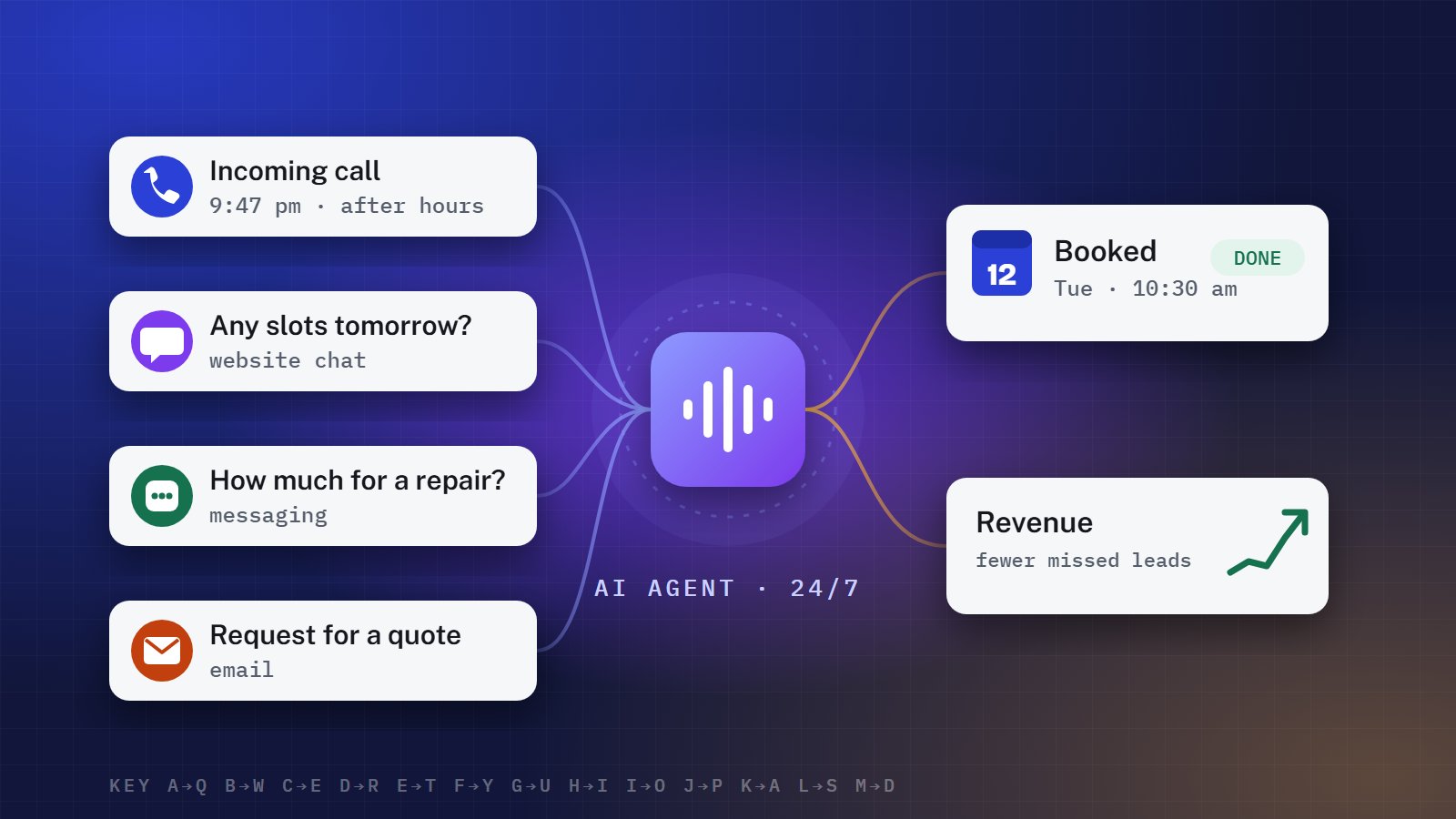
Most businesses don't have a lead problem. They have a catching problem. The phone rings while everyone is with a customer. A website visitor asks a question at 11 pm and leaves when nobody answers. A promising enquiry sits in an inbox until Monday, and by then the customer has booked with someone else.
Each of those is revenue you already paid to attract, through ads, SEO or word of mouth, and then lost at the last step. AI agents are good at exactly that last step.
What is an AI agent for business?
An AI agent is software that holds a real conversation with your customers and can take actions while it does. Unlike the old menu-driven chatbots ("press 1 for sales"), it understands questions in everyday language, answers from your own information, and does things in the tools you already use: it checks your calendar, books a slot, creates a lead in your CRM or sends a confirmation.
Agents work on the channels your customers already use:
- Voice agents answer phone calls, talk naturally, and book, reschedule or route calls.
- Chat agents sit on your website and answer visitors the moment they ask.
- Messaging agents reply on WhatsApp, SMS or Instagram, where many customers prefer to write.
- Email agents draft or send first replies to enquiries, so nobody waits days for an answer.
Analysts expect agents to take on much more of this work. Gartner predicts that by 2029, agentic AI will autonomously resolve 80% of common customer service issues without human intervention.
Where does a business lose opportunities?
Lost opportunities are rarely dramatic. They are small leaks that happen every day:
- Missed calls. Calls at lunch, during busy hours or after closing go to voicemail, and many callers never leave a message. They simply call the next business on the list. In Invoca's analysis of more than 70 million calls to businesses across 10 industries, only 56% were answered by a person, yet 42% of phone leads converted during the call.
- Slow replies. A customer who asks about price or availability is usually asking two or three businesses at once. The first useful answer often wins. According to HubSpot, 90% of customers rate an "immediate" response as important or very important when they have a customer service question, and a Harvard Business Review study of online sales leads found that most companies are not responding nearly fast enough.
- After-hours enquiries. Evenings and weekends are when many people finally have time to look for a service, and when most businesses are closed.
- No follow-up. Quotes that are never chased, and people who started a booking and stopped, are often the warmest leads a business has.
- Staff time spent on repeats. Answering "Are you open on Sunday?" for the twentieth time takes your team away from customers who are ready to buy.
How do AI agents turn lost opportunities into revenue?
| Where the lead leaks | What the agent does | What it is worth |
|---|---|---|
| Missed and after-hours calls | Answers every call, 24/7, and books or takes details | Bookings that would have gone to a competitor |
| Slow replies to enquiries | Replies in seconds with accurate answers | More enquiries turn into conversations |
| Unqualified leads | Asks the right questions first: need, budget, timeline | Your team spends time on buyers, not browsers |
| Abandoned bookings and quotes | Follows up by message at the right time | Revenue recovered from people who were already interested |
| Repetitive questions | Handles FAQs, opening hours, pricing and order status | Staff time freed for sales and service |
| Peak-time overload | Handles many conversations at once | No queue, no "please hold" |
The pattern is the same in every row: the agent doesn't invent new demand. It makes sure the demand you already have gets a fast, helpful answer.
Which kind of AI agent does your business need?
Start where your customers already contact you, and where you lose the most.
- Clinics, salons, repair and home services: a voice agent first. These businesses live on phone bookings, and a missed call is often a missed job.
- Online stores and SaaS products: a chat agent on the website for pre-sales questions, plus order status and returns.
- Restaurants, real estate, education and local retail: a WhatsApp or SMS agent, because that is where customers ask questions and expect quick replies.
- B2B services and agencies: a chat or email agent that qualifies enquiries and books a call into your calendar.
Many businesses end up with two channels sharing the same knowledge, for example a phone agent and a website chat that give the same answers.
How do you estimate the revenue you are losing?
You can make a rough estimate in five minutes with numbers you already have:
- Count the missed enquiries in a typical week: unanswered calls, chats with no reply, and messages answered the next day.
- Estimate how many would have bought. Use your normal conversion rate for enquiries that do get answered.
- Multiply by your average sale.
For example, take a business that misses 20 calls a week, normally turns 25% of answered calls into bookings, and earns an average of 2,000 (in its own currency) per booking. That is 20 × 0.25 × 2,000 = 10,000 a week in revenue that rang the phone and went elsewhere, or over 500,000 a year. Your numbers will differ, but doing this sum usually shows that the cost of missed enquiries is much bigger than it feels day to day.
Then compare that figure with what an agent costs to build and run. That is your business case.
What should an AI agent hand over to a person?
An agent should know its limits, and it should support your team rather than replace it. Gartner predicts that half of the companies that cut customer service staff because of AI will rehire by 2027. Set clear rules for when the agent passes the conversation to your team:
- The customer asks for a person.
- The question is outside what the agent was given, or it isn't sure.
- The topic is sensitive: complaints, refunds, medical, legal or financial advice.
- A large order or a high-value client needs a personal touch.
A good handover includes the full conversation and the customer's details, so nobody has to ask the same questions twice.
How do you get started with AI agents?
- Pick one leak. Choose the single biggest source of lost enquiries, such as missed calls or slow website replies.
- Write down what the agent must know: services, prices, hours, policies and the 20 questions customers ask most.
- Connect the tools it needs to act: your calendar, CRM, booking system or order database.
- Set the guardrails: what it may answer, what it must hand over, and how it introduces itself.
- Launch on one channel and measure. Track answered enquiries, bookings and handovers, then improve the answers each week.
- Expand to the next channel once the first one is paying for itself.
What does this look like in practice?
The Ask us assistant on this website is a small example. It answers questions about our products and services at any hour, says plainly when it doesn't know something, and points people to our team by email when they are ready to talk. We build the same kind of agent for other businesses, from website chat to voice agents that answer the phone and book appointments, connected to the tools you already use.
If you want to find out where your business is losing enquiries and what an agent could recover, book a free 15-minute call or tell us about your business.
Sources
- Invoca, 7 Insights From Analyzing 70 Million Phone Conversations: 2026 Report, July 2026.
- HubSpot, Customer service standards, updated May 2025.
- Oldroyd, McElheran and Elkington, The Short Life of Online Sales Leads, Harvard Business Review, March 2011.
- Gartner, Agentic AI will autonomously resolve 80% of common customer service issues without human intervention by 2029, press release, 5 March 2025.
- Gartner, Half of companies that cut customer service staff due to AI will rehire by 2027, press release, 3 February 2026.
Frequently asked questions
Will customers know they are talking to an AI?
They should. A good agent says it is an AI assistant at the start and offers a person when asked. Being upfront builds trust, and in some places it is a legal requirement.
Can an AI agent replace my receptionist or support team?
It works best alongside them. The agent handles the repetitive questions, bookings and after-hours enquiries, and your team gets fewer interruptions and better-prepared leads for the conversations that need a person.
What happens when the agent doesn't know the answer?
It should never guess. A well-built agent says it will check, takes the customer's details and passes the question to your team with the full conversation attached.
Does it work in languages other than English?
Yes. Modern AI models understand and reply in many languages, so one agent can serve customers in English, Hindi and other languages, often switching to match whoever is talking.
Is my customers' data safe with an AI agent?
It depends on how the agent is built. Keep keys and data on your own servers or a trusted cloud, collect only what the conversation needs, and choose AI providers that don't train on your data.